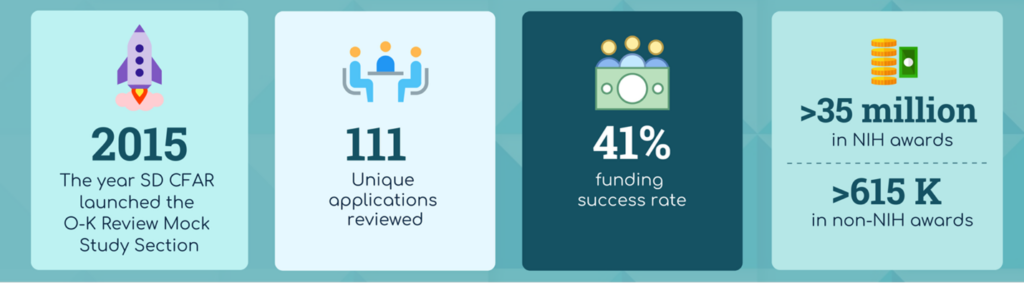
The O-K Review Committee facilitates a mock study section that provides critical reviews and constructive feedback on select NIH grant applications before submission. The committee primarily focuses on K awards while also accepting F, R01, and R21 applications from first-time submitters. Members of the committee include Drs. Mary Lewinski, Laramie Smith, Sara Gianella, Eileen Pitpitan, and Joe Ix.
Initially established for HIV/AIDS applications, this process has been extended to applicants from the Department of Medicine (DOM) for topics beyond this focus area. Those who submit applications for review are encouraged to evaluate their peers’ submissions, enabling them to experience the review process from both perspectives.
We hope that the insights gained from these mock study section reviews, as well as the networking connections made, will have a lasting impact well beyond the NIH due dates. Best of all, this valuable service is offered free of charge!
NOTE: As of May 2026, the O-K Review cycle will be offered only three times a year, aligned with the standard NIH submission deadlines of February, June, and October. This is in accordance with NOT-OD-26-029.
Applications will undergo a Full Review only if the following requirements are met; otherwise, they will receive a Limited Review, which includes written feedback but excludes participation in a panel review:
As part of the review and learning process, you will be asked to serve as a reviewer for one of the other submitted applications. Specific Aims must be submitted by the specified deadline to participate in the O-K Review process.
It is important for SD CFAR to know the outcome of investigator’s participation in the O-K Review process. It is a key indicator used to document value-added as well as to justify resources allocated to the O-K Review. If you have participated in the O-K Review in the past, you must have provided NIH funding outcome information for prior applications to the Administrative Core (cfar@ucsd.edu) to be eligible to participate.
| Item | Action | Due Dates: June 2026 Submission Cycle | Due Dates: May 2026 Submission Cycle | Due Dates: February 2027 Submission Cycle |
|---|---|---|---|---|
| Specific Aims | Specific aims of the proposed application with the SD CFAR cover sheet should be submitted no later than this date in order to participate in the OK Review mock study sections. SUBMISSION FORM Late submissions will not be accepted | Monday, April 6, 2026 | Monday, August 3, 2026 | Monday, November 23, 2026 |
| Application | Applications submitted for review by 5:00 pm PT. Applicants must have submitted their Specific Aims by the April 9 deadline to receive an application link and to participate in the OK Review mock study section for this cycle. | Monday, April 20, 2026 | Monday, August 17, 2026 | Monday, December 7, 2026 |
| O-K Review Panel | O-K Review panel via Zoom, NOTE: All applicants are expected to be present at this meeting. | Tuesday, May 5, 2026 12:00 – 3:00 pm PT | Tuesday, September 1, 2026 8:00 – 11:00 am PT | Monday, January 11, 2027 2:00 – 5:00 pm PT |
| Submit to NIH | Applications due at NIH. This timeline is based on standard Medicine application deadlines, your application may have a different deadline. Applicants are responsible for verifying due dates with NIH. | Friday, June 5, 2026 | Monday, October 5, 2026 | Friday, February 5, 2027 |
As part of the review and learning process, you will be asked to serve as a reviewer for one of the other submitted applications. As noted above, all applicants are expected to attend and participate in the Zoom review panel. If you are unable to do so, you will receive a limited review only. Additionally, if partial documents are submitted, there will be a limited review only. Specific Aims must be submitted by the stated deadline in order to participate in the O-K Review process.
It is important for SD CFAR to know the outcome of investigator’s participation in the O-K Review process. It is a key indicator used to document value-added as well as to justify resources allocated to the O-K Review. If you have participated in the O-K Review in the past, you must have provided NIH funding outcome information for prior applications to the Administrative Core (cfar@ucsd.edu) to be eligible to participate.
Note:
If you are interested in participating as a reviewer one or more of the above mock study sections, please email cfar@ucsd.edu.
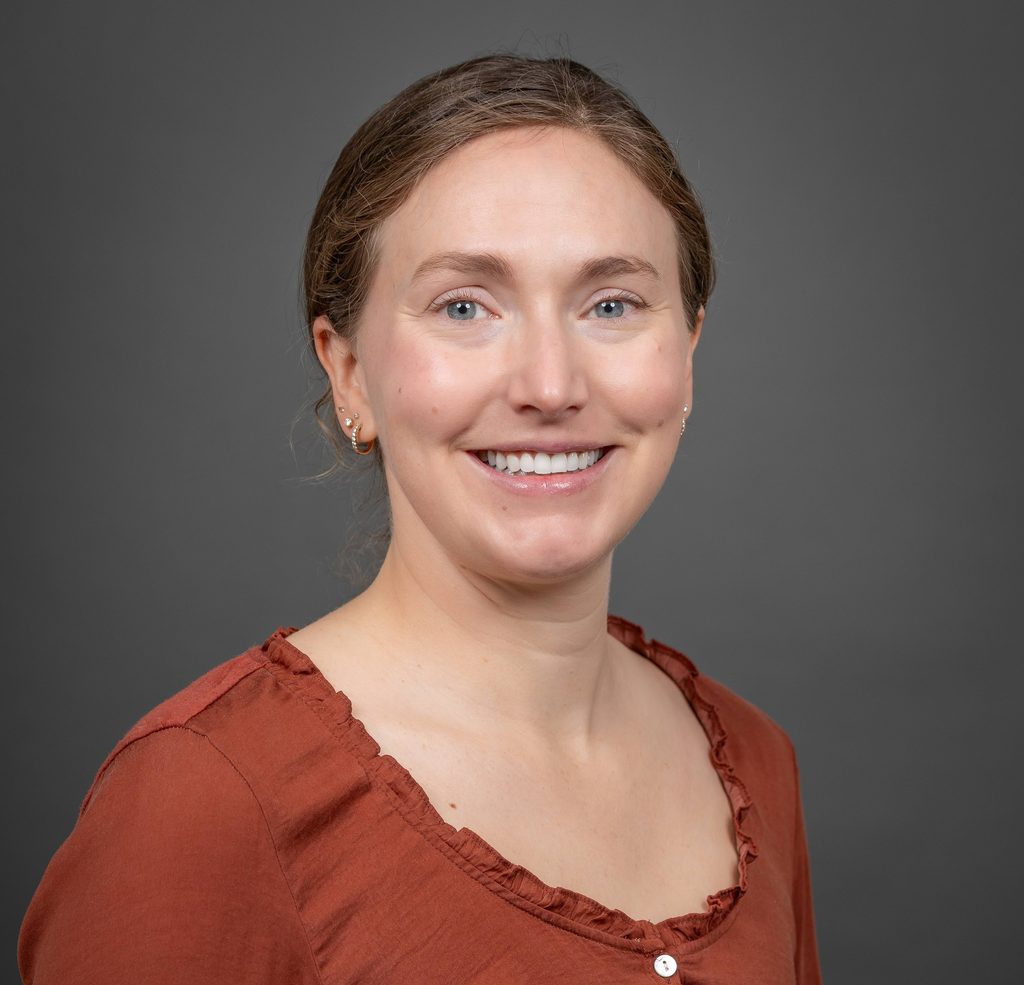
1K23AI195015-01A1 | “Impact of Exogenous Estrogen on Innate Immune Responses in Individuals with HIV”
Coming to grant writing from a traditional medical training path, I found writing my first K award incredibly challenging. I had spent my entire career learning how to care for patients and practice medicine, but as an Infectious Diseases fellow transitioning into research, I had essentially no experience with grantsmanship or with how NIH reviewers approach an application. The O-K Review provided candid feedback from experienced investigators, helping me identify weaknesses in my application, communicate my science more clearly, and navigate the steep learning curve of entering research after years of clinical training.
That support felt especially critical during a period of tremendous uncertainty in the research environment, when the broader political climate and evolving limitations imposed by the NIH added another layer of complexity to an already difficult process.
As a physician, I will always value the impact I can have on the individual patients I care for, but research has given me the opportunity to extend that impact far beyond my own clinic and to improve health at a population level. Whatever impact my future research ultimately has, I will always consider the O-K Review an important part of the foundation that helped me get there.
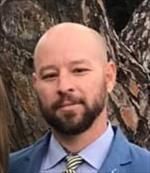
“Mitochondrial biogenesis dysfunction in the CNS of HIV-infected individuals on antiretroviral therapy”
“The OK-Review process was instrumental in the crafting my K01 application. I struggled for 2+ years to write a fundable K-application and establish a clear pathway to independence as a principal investigator. After multiple attempts of getting scored just outside the funding range, twice the reviewers of the OK-Review committee helped me get my score cut in half. The OK-Review team provided the sort of constructive and unbiased criticism that is needed to get through the NIH review process.
On the other hand, reviewing applications through the OK-Review process has also served as a valuable tool for my development as a scientist. I strongly suggest that trainees take advantage of this tremendous resource for career development.”